Torah Classes
Monday Night Class
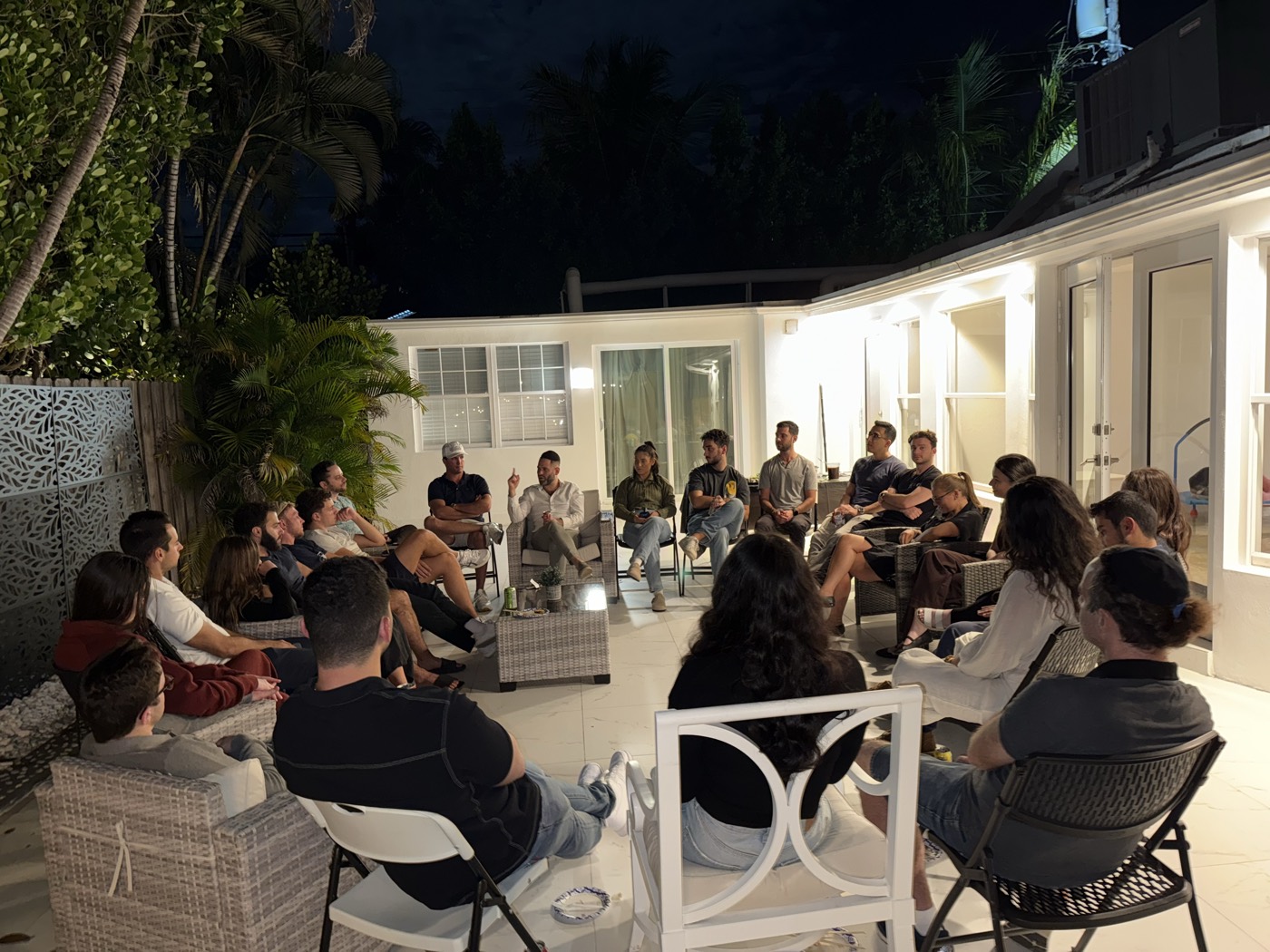
In person in Miami, most Monday nights: one big question, straight from the Torah. Missed one? The recording and notes are here.
Monday, October 19, 2026
What the Dove Said
After a run through Parshas Noach, one question: what does a thing say just by being what it is? The dove that came back with an olive leaf never spoke, and still Noach understood her. The Maharal explains how, and it leads to what a neshama really is, and to why a husband who marries to give is counted as if he gave birth to his wife.
Monday, October 12, 2026
A Helper Against Him
Hashem made the woman an ezer kenegdo, a helper opposite the man, and Rashi reads it both ways: if he merits, she is a helper; if not, she is against him. Why would the same woman be one or the other, and what does it take to merit? The Maharal's answer: man and woman are equals and opposites, and two opposites either fuse into the strongest bond there is or push each other away.
Wednesday, October 7, 2026
Why Do They Hate Us?
October 7 brings two questions with it. Why does the world hate the Jewish people? And how have we survived it, through every tragedy, when no other nation has? The Torah is the blueprint of the world, and it answers both at once.
Daily Torah Class
Sunday through Friday at 12:05pm Eastern on Google Meet, following the week's parsha. Missed one? The recording, a summary and review questions are here.
Lech-Lecha

Sunday, October 18, 2026
Lech-Lecha 1
This class opens Parshas Lech Lecha and covers Bereshis 12:1–9: Hashem's command to Avram to leave, the blessings he is promised, his departure from Charan at seventy-five with Sarai, Lot and "the souls they made," and his arrival in Canaan, where he builds altars and heads south toward Mount Moriah. Two ideas keep coming back. The first is effort and follow-through: Avram sets out without knowing where he is going, he does not stop halfway the way his father Terach did, and he leaves purely because Hashem said so. The second is close reading: a singular "he who curses you," a doubled "with them," and the spelling of "his tent" each turn out to hold a lesson. Along the way we go through the sixteen blessings packed into Hashem's promise and the two separate journeys Avram made out of Charan.

Monday, October 19, 2026
Lech-Lecha 2
Bereshis 12:10 through 13:18. Avram goes down to Egypt in a famine, Sarai is taken to Pharaoh's palace, and Avram leaves rich. He then returns to Canaan, separates from Lot and receives the promise of the land. Along the way we look at where Pharaoh came from, as Sefer HaYashar tells it. One question runs through all of it: how much is a person meant to rely on Hashem, and how much on his own planning? Rashi and the Ramban answer it differently in the famine, and the Ramban raises it again in the plan to call Sarai his sister. A second thread is that what happened to the Avos (the forefathers) is a sign of what would happen to their children. Avram's descent and rich exit point to the Egyptian exile, and Pharaoh's plagues point to the ten plagues.

Tuesday, October 20, 2026
Lech-Lecha 3
Bereshis 14 tells of the first world war in history: four kings led by Kedorlaomer, with Nimrod among them, against the five rebel kings of the Sodom region. It goes through Lot's capture, Avram's rescue with 318 men, his meeting with Malki Tzedek and his refusal to take anything from the king of Sodom. One idea keeps coming back: the whole war was really about Avram. Nimrod wanted to draw him out and kill the "eye of judgment," and Shem set events in motion so that Avram would win and become known. The second idea is what happens to a person who chooses to live among the wicked, as Lot did. A timeline at the end fits the war into Avram's life.
Wednesday, October 21, 2026
Lech-Lecha 4
Here we finish the aftermath of Avram's war with the four kings, then cover Bereshis 15:1–6: Hashem's "do not fear," Avram's worry about having no heir, the night Hashem took him outside to look at the stars, and his faith. It opens with the laws of redeeming captives and the six things Avram gained by going to war, including the reward of six mitzvos for refusing even a thread or a shoelace. Two ideas keep coming back. The first is that merit is real and can be used up, which is why Avram was afraid after a miraculous victory. The second is that a Jew is not ruled by the stars or by the angels placed over the nations, because Hashem watches over him directly. It closes with the Ramban's reading of "he counted it as righteousness": Avram saw the promise as Hashem's kindness, not as something he had earned.
Thursday, October 22, 2026
Lech-Lecha 5
This class covers Bereshis 15:7–21, the Bris Bein HaBesarim (the covenant between the halves), and then 16:1–16, the story of Hagar and the birth of Yishmael. Hashem promises Avram the land, Avram asks how he can know it will stay with his children, and the covenant is sealed with the split animals and the torch of fire. Two ideas keep coming back. The first is that the promise is real but conditional: the four exiles are woven into the covenant itself, and exile is the gentler payment Avram chose for his descendants in place of Gehinnom. The second, in the Hagar story, is that the same words land differently depending on the person hearing them.
Noach
Sunday, October 11, 2026
Noach 1
The opening of Parshas Noach, Bereshis 6:9 through 7:4, covers Noach's righteousness, the corruption that brought the Flood, the building of the ark, and the seven-day delay before the rain. One idea keeps coming back. The Flood was decreed for chamas, the ordinary, "everyone does it" dishonesty that wears away peace, truth and justice, and Noach stood out because he refused to join in, even as he gathered food for the ark. A second thread runs through the ark itself. Noach does every part that human effort can do, and Hashem adds the miracle only where it is needed.

Monday, October 12, 2026
Noach 2
This class covers Bereshis 7:5–24, from Noach boarding the ark to the 150 days of surging water, and stops at the opening of chapter 8. The main question is what Noach got wrong. He waited until the floodwaters forced him into the ark, and, more seriously, he never prayed for his generation, which Moshe later threw back at him. Around the verses come the scenes at the ark: the crowds and the lions, the re'em and Og who couldn't fit inside, why the rain lasted forty days, and a year of exhausting work caring for the animals. The class ends with a close reading of "ach Noach": the word "ach" (only) also teaches that Noach himself came out of the ark diminished.

Tuesday, October 13, 2026
Noach 3
Bereshis 8:1 to 9:4 tells of the end of the flood and the new start after it: the waters going down, the raven and the dove, leaving the ark, Noach's offering, Hashem's oath and the seasons, and the blessings and the permission to eat meat that open chapter 9. Two ideas keep coming back. The first is measure for measure: the generation's fiery lust brought boiling water, their pride about the sun brought a full solar year, and the merits of Noach and the animals brought the flood to its end. The second is that Hashem does not change, but the way His world treats us depends on what we are. Justice can be mercy for the righteous, and animals fear a person only while he lives on the level of a human being.
Wednesday, October 14, 2026
Noach 4
These verses, Bereshis 9:5–29, finish the story of Noach. It covers Hashem's fifth promise after the flood and the laws of murder that come with it, the command to have children, the rainbow as the sign of the covenant, Noach's vineyard and drunkenness, Chom's sin, the curse of Canaan, the blessings of Shem and Yefes, and Noach's death in Avraham's lifetime. One theme keeps coming back: how much a human life is worth. That theme runs through the laws of murder, suicide and danger, and through the command to fill the world again. The second theme is measure for measure, which shapes the fate of Noach's three sons.

Thursday, October 15, 2026
Noach 5
This class covers the family tree of Bereishis 10, which lists the seventy nations that came from Noach's sons, and then the Tower of Bavel in Bereishis 11:1–9. Along the way it follows Nimrod's rise from a "trapper" of minds to the first king to rule other men, and Ashur's flight from his influence. Two ideas keep coming back. First, a generation only 340 years after the flood forgot its lesson and turned the whole world, with one voice, against Hashem. Second, that same generation lived in peace with one another, and this is why, unlike the generation of the flood, they were scattered and punished but not wiped out.
Friday, October 16, 2026
Noach 6
This class finishes Parshas Noach, from Bereshis 11:10 to the end of the chapter: the ten generations from Shem down to Terach, the birth of Avram, the death of Haran, the marriages of Avram and Nachor, Sarai's barrenness, the family's move to Charan, and Terach's death. The genealogy shows that the story of creation reached us through an unbroken chain of people who knew one another. Most of the class follows the Me'am Loez through Avram's early life: Nimrod's attempt to kill him as a baby, his search for Hashem, the idol shop, and the fiery furnace of Ur Kasdim. The idea that keeps coming back is Avram's fearlessness: one man standing up to the whole world, and to its king, for the truth.
Bereshis
Tuesday, September 29, 2026
Bereshis 1
This first class of the new cycle covers the first twelve pesukim (verses) of Bereshis: why the Torah opens with creation, and what Hashem made on the first three days. It begins with an introduction to the Me'am Loez, the commentary we are learning, and a ground rule for learning Kabbalah. Two ideas keep coming back: the world was created for people to keep the Torah, and there are things about creation we are told not to probe.

Wednesday, September 30, 2026
Bereshis 2
Days four and five of creation: the sun, moon and stars, then the fish, the birds and the great creatures of the sea. Where the light of the sun came from if light was already made on day one, why the moon is the smaller light, and what the Livyasan is. Then a look past our own world, at the seven earths, the planets and the stars, and the Jewish calendar that follows the moon. One idea runs through it: all of this vast creation was made for people who keep the Torah, and none of it runs by itself.
Thursday, October 1, 2026
Bereshis 3
The sixth day of creation ends with Bereshis 1:24–25, the land animals, and then the Torah turns to the making of man in Bereshis 1:26–27. Here we deal with "Let us make man": why the Torah uses the plural, what the angels had to do with it, and why Hashem left room for people to misread it. Following the Me'am Loez, we then go through the human body part by part, asking what each part was made for. Two ideas keep coming back. A person is a small world that holds something of all creation plus a soul from Hashem Himself. And a person's hands, speech and mind are there for a purpose higher than eating and drinking: to learn Torah, keep the mitzvos and let the intellect lead the instinct.

Friday, October 2, 2026
Bereshis 4
This class finishes the six days of creation and reaches Shabbos, covering Bereshis 1:28 through 2:3. Before the verses come the ten things created at twilight on the first Erev Shabbos and the shedim (demons) left without bodies when Shabbos began. The verses cover the mitzvah to marry and have children, the food given to man and animals, "very good," Vayechulu, Hashem ceasing on the seventh day, and the blessings of Shabbos. Two ideas keep coming back. First, creation was built with a purpose: everything was made for man and set up to bring the Jewish people to accept and keep the Torah. Second, Shabbos testifies that the world Hashem made is complete, with nothing missing.
Monday, October 5, 2026
Bereshis 5
This class covers Bereshis 2:4–7. Here the Torah moves from the general picture of the six days to the details, above all the creation of Adam. We look at the small hey in "behibar'am," why Hashem's four-letter name first appears here, why the plants waited for Adam's prayer, why the world is watered by rain, and how man was formed from dust and given a soul. Two ideas keep coming back. Hashem made us needy and lowly so that we stay humble and keep looking up to Him. And the soul Hashem breathed into us is ours to build through free will, Torah and mitzvos.
Tuesday, October 6, 2026
Bereshis 6
These notes cover Bereshis 2:8 through 3:13: the layout of the Garden of Eden and its four rivers, Adam's place and commandments, the naming of the animals, the creation of Chava (Eve), and the serpent and the first sin, up to Hashem asking "Where are you?" Two ideas keep coming back. First, Hashem prepared everything for man ahead of time and with great care: the garden, the commandments, and a partner. Second, the sin was not foolish. Adam and Chava were very wise, and the serpent was clever. It came dressed as a righteous advisor and built its case on careful reasoning, and each of them had reasons that turned out to be wrong. The lessons about home are just as practical: be generous in marriage, don't fuss over small details, and correct people gently.
Wednesday, October 7, 2026
Bereshis 7
Bereshis 3:14–19 tells of the curses that followed the sin of the Tree of Knowledge. The serpent, Chava and Adam each receive ten curses, and many of them match the sin they punish, measure for measure. One idea keeps coming back: the serpent's sin was a sin of speech, and that is why its punishments carry such a strong warning about lashon hara (speaking badly about others). It all ends on death itself: why it came into the world, how it also cleanses a person, why Adam still lived 930 years, and the promise that in the days of Mashiach death will be swallowed up forever.

Thursday, October 8, 2026
Bereshis 8
This class runs from the end of the Gan Eden story to Kayin's family, Bereshis 3:20 through 4:22. It covers Chava's name, the leather garments Hashem made, the Tree of Life being closed off, and Adam's repentance. Then come Kayin and Hevel: their offerings, Hashem's warning to Kayin, the murder, Kayin's punishment and his mark, and the builders, musicians and weaponsmiths who came from him. Two ideas keep coming back. First, free will means a person has to earn his own perfection. Second, real teshuva (repentance) is not guilt or a half-hearted confession. It means turning regret into fuel and making a real change, and a partial confession earns only a partial reprieve.

Friday, October 9, 2026
Bereshis 9
This class finishes Parshas Bereshis. It starts with Lamech and his wives at the end of chapter 4, then the births of Sheis and Enosh. From there it goes through the ten generations of chapter 5, from Adam to Noach, and ends with the first eight pesukim of chapter 6: the corruption of the generation of the Flood, Hashem's decree, and Noach finding favor. One idea keeps coming back: corruption starts small and grows. A well-meant honoring of the stars turned into worship of idols until Hashem was forgotten, and the sins of Enosh's generation changed people's faces and nature itself. By the generation of the Flood, immorality and robbery were simply the norm. The other idea is responsibility. Each person dies for his own sins, not Adam's. We have to do what Hashem commands and leave His decrees to Him, and whoever knows Torah carries responsibility for those who don't.